
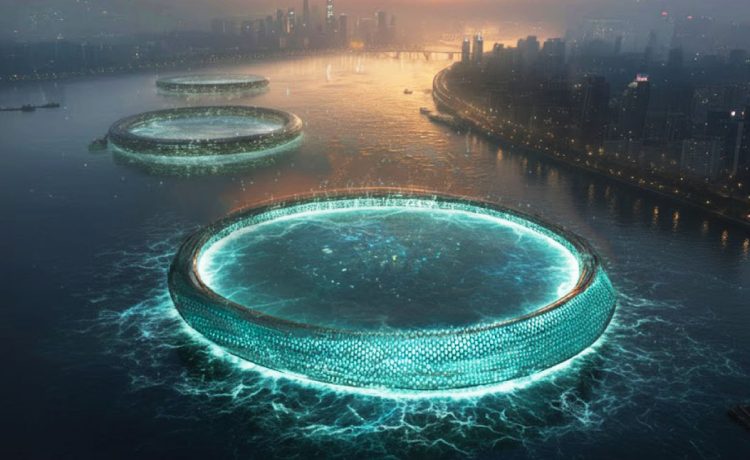
A new generation of speculative architecture is beginning to challenge not just how cities are built—but what they are built to heal. The Microbiome Swarm Net, recognized in the eVolo Skyscraper Competition 2025 awards, represents one of the most forward-thinking responses to a growing global crisis: microplastic pollution in the world’s oceans. Rather than existing as a fixed tower, this concept redefines the skyscraper as a decentralized, living system—one that operates across marine environments to actively filter and restore ecological balance.
Vision & Strategic Positioning
The Microbiome Swarm Net positions architecture as environmental infrastructure rather than urban object. It proposes a network of autonomous, floating modules that function collectively—more like a biological organism than a building.
At its core, the concept addresses a critical gap in current sustainability efforts: while waste reduction policies continue to evolve, the accumulated microplastics already dispersed across oceans remain largely unaddressed at scale.
Key strategic ideas include:
- Transitioning architecture from static landmarks to adaptive environmental systems
- Integrating biotechnology with built environments
- Expanding the definition of “skyscraper” beyond vertical urban density
- Positioning oceans as the next frontier for architectural intervention
Master Plan & Core Components
Rather than a single structure, the Microbiome Swarm Net is composed of thousands of interconnected floating units—each designed to operate independently while contributing to a larger network.
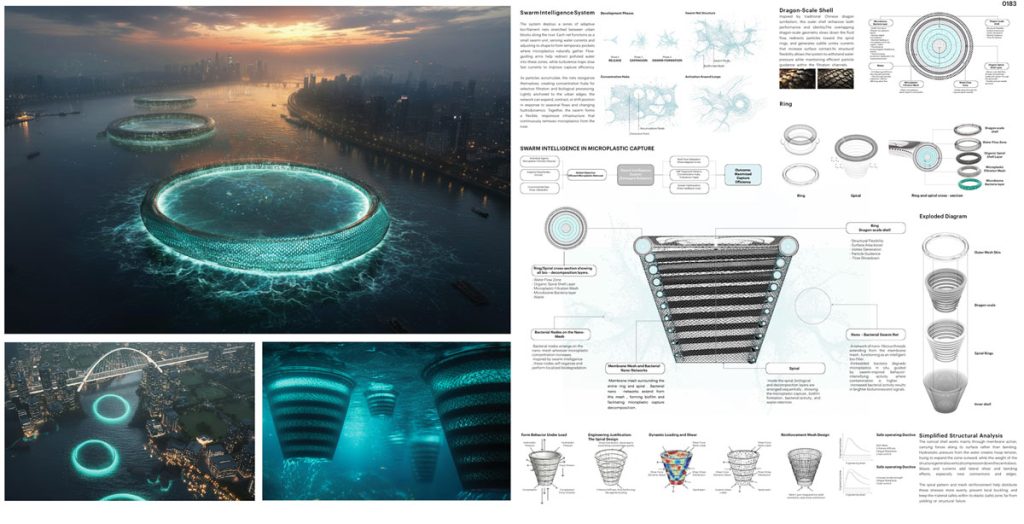
Each module includes:
- Bio-reactive filtration membranes engineered to capture microplastics at microscopic levels
- Microbial ecosystems designed to break down synthetic particles into less harmful compounds
- Solar-integrated exteriors enabling energy self-sufficiency
- AI-driven navigation systems allowing modules to cluster in high-density pollution zones
The system behaves like a swarm—constantly reorganizing itself based on ocean currents, pollution data, and environmental conditions.
The concept was developed by a multidisciplinary team of designers and researchers, bringing together expertise across architecture, marine science, and environmental engineering. As with many eVolo Skyscraper Competition award-winning proposals, the Microbiome Swarm Net reflects a collaborative design approach rather than a single studio authorship—highlighting the growing role of cross-disciplinary teams in shaping future infrastructure concepts.
Development & Investment Potential
As a conceptual project, the Microbiome Swarm Net is not currently scheduled for development. However, its underlying ideas align closely with emerging investment trends in climate technology and ocean remediation.
Potential pathways to realization include:
- Public-private partnerships focused on marine sustainability
- Integration with global environmental initiatives and climate funds
- Collaboration with coastal nations and island economies most affected by ocean pollution
- Scaling through modular manufacturing and deployment strategies
The concept highlights how future infrastructure investment may extend beyond cities into planetary systems—particularly as environmental challenges demand global-scale responses.
Sustainability & Innovation
The Microbiome Swarm Net operates at the intersection of architecture, biotechnology, and artificial intelligence.
Core innovations include:
- Biodegradation systems using engineered microbes to process plastics
- Distributed energy systems powered by solar and oceanic motion
- Self-organizing networks that adapt in real time to environmental data
- Low-impact materials designed for long-term marine deployment
Unlike traditional sustainability models that focus on reducing harm, this concept emphasizes active repair—positioning architecture as a regenerative force.
Challenges & Considerations
Despite its visionary approach, the project raises important technical and ethical questions:
- The long-term ecological impact of introducing engineered microbes into marine environments
- Maintenance and durability of floating infrastructure in extreme ocean conditions
- Governance of international waters and deployment jurisdiction
- Economic feasibility at the scale required to meaningfully impact global pollution levels
These challenges underscore the gap between conceptual innovation and real-world implementation—while also highlighting areas for future research and policy development.
Urban Impact & Legacy
While not urban in the traditional sense, the Microbiome Swarm Net expands the influence of architecture beyond city boundaries. It suggests a future where architects design systems that operate across ecosystems, not just skylines.
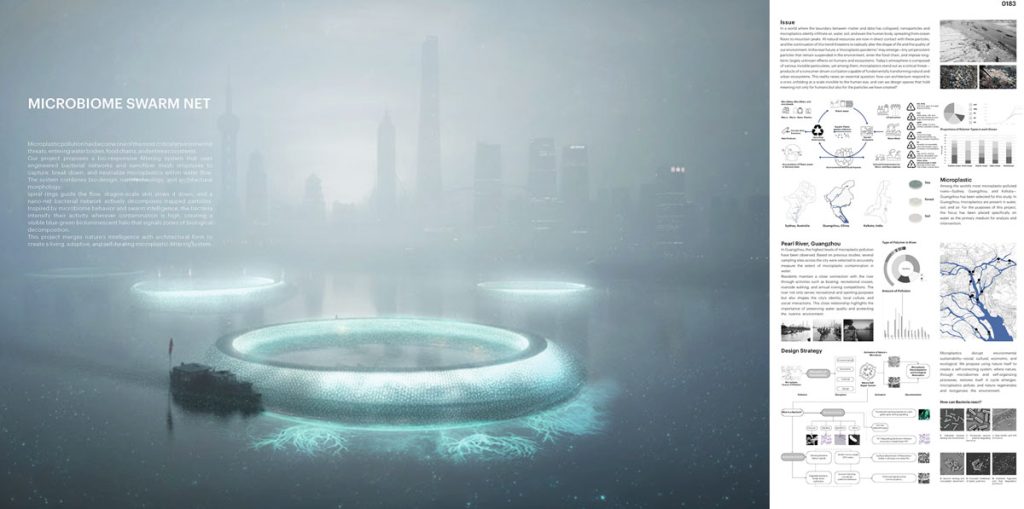
Its legacy lies in redefining:
- What qualifies as a skyscraper
- Where architecture can exist
- How design can contribute to planetary health
In doing so, it aligns with a broader movement toward regenerative design—where the built environment actively contributes to environmental restoration. The Microbiome Swarm Net stands as a powerful example of speculative architecture’s role in shaping future possibilities. Though not yet feasible at scale, it introduces a new framework for thinking about infrastructure—one that prioritizes adaptability, ecological integration, and global impact.
As environmental pressures intensify, concepts like this may move from visionary proposals to essential systems—reshaping how architecture participates in the health of the planet.
Project Facts & Figures
- Project Name: Microbiome Swarm Net
- Type: Conceptual Environmental Infrastructure
- Recognition: 2025 eVolo Skyscraper Competition award winner
- Designers: Multidisciplinary conceptual team (architects, marine researchers, environmental technologists)
- Function: Microplastic filtration and ocean remediation
- Structure: Decentralized floating modular network
- Energy Source: Solar and kinetic ocean energy
- Key Technologies: AI navigation, microbial biodegradation, bio-filtration systems
- Status: Theoretical concept (not scheduled for construction)